Anton “Tomi” Argana
Analytics Manager, Trade Sales — Reckitt, Philippines
My job is turning messy retail data into numbers a commercial team will actually act on. I do that end to end myself — ingest and clean the data, build the model, ship the result. Outside that job I built Project Atlas, a location-intelligence platform for Philippine retail, alone, from the database up.
This page isn’t selling anything. It exists so you can judge whether I know what I’m doing — so every claim on it points to somewhere you can check it.
- Name
- Anton “Tomi” Argana
- Role
- Analytics Manager — Trade Sales
- Company
- Reckitt · Philippines
- Works in
- Python · SQL · TypeScript · Power BI
- Side build
- Project Atlas PH — built solo
What I can do — and where to check it
Machine learning
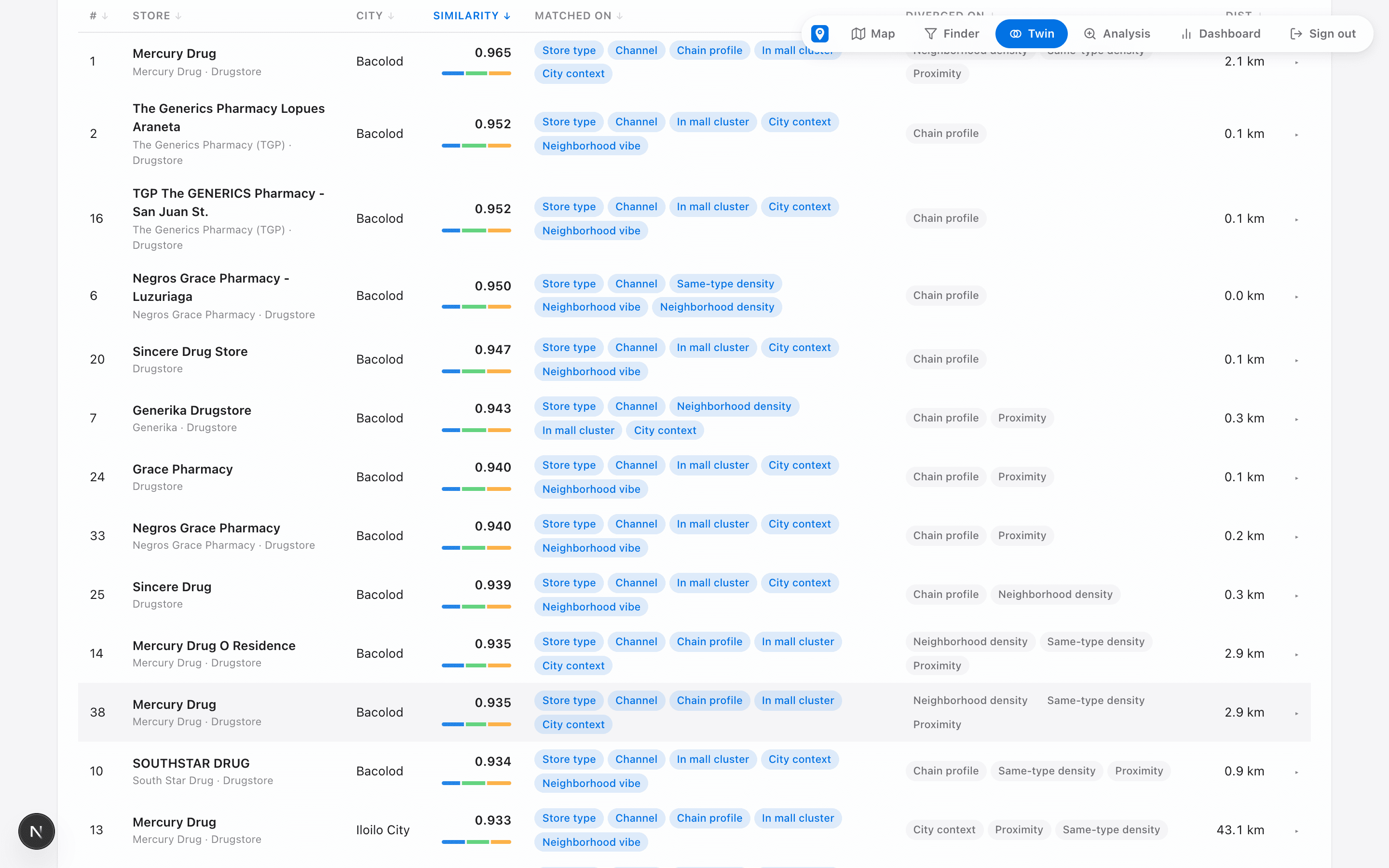
The core of Atlas is a store-similarity engine I designed and tuned end to end: 74 feature dimensions per store, vector embeddings with diversity re-ranking, scored across 119,074 stores and calibrated against real outcomes rather than eyeballed.
Data engineering
Everything the models read is produced by pipelines I wrote — scheduled feature precomputes for every store and point of interest, plus bulk imports like 162,497 land-value records and 42,000+ barangay boundaries, each with its origin recorded.
Full-stack engineering
The platform itself: Next.js 15, React 19, TypeScript and PostgreSQL — schema, auth, APIs, maps and UI. Designed, built, deployed and maintained by one person since the first commit.
Analytics a sales team runs on
The day job: trade-sales analytics at Reckitt — the weekly numbers, models and Power BI dashboards a field sales organisation actually operates on, not one-off decks.
Project Atlas, measured
These aren’t marketing numbers — they’re what the system holds and does today, counted from the database and the test suite.
Calls I made, and why
Anyone can list technologies. Judgment shows in the decisions — especially the ones that removed something, or made a failure visible.
Road distance, not straight lines.
Distances come from a road-routing engine, because a river between two stores matters. When routing is unavailable, the app shows a loud warning and says its estimates are straight-line — the failure mode is visible by design, not hidden.
Reports are deterministic.
An early version generated report copy with an LLM. I took it out: a number you can’t reproduce is a number you can’t defend in a business review. Same inputs, same report, every time.
No figure without a source.
Every statistic traces to a named dataset — PSA, DHS, BIR, DOT, or published research — and where the data is thin, the page says so in plain sight rather than in a footnote.
The database changes by migration only.
Schema history is versioned and reviewable. Nothing has ever been hand-edited against production — the boring discipline that makes every other claim on this page auditable.
Locked by default.
Every page and API has required a signed session since the first commit. The public pages are a short, explicit allow-list — the opposite of “we’ll secure it later.”
The best reference is the product. Don’t take this page’s word for any of it — open the demo and poke at it.